Table Of Content
Other designs such as Plackett-Burman or a General full factorial design can be chosen. It is clear that in order to find the total factorial effects, you would have to find the main effects of the variable and then the coefficients. A null outcome situation is when the outcome of your experiment is the same regardless of how the levels within your experiment were combined. From the example above, a null outcome would exist if you received the same percentage of seizures occurring in patients with varying dose and age.
Minitab DOE Example
However, they also reveal information that is unique and of potentially great value. Further, this problem is reduced if factorial designs are used as screening experiments, whose purpose is not to identify the single best combination of ICs (Collins et al., 2009). Rather such experiments are used to identify the ICs that are amongst the best. Therefore, finding that several combinations of ICs yield promising effects is compatible with the goal of a screening experiment, which is to distill the number of ICS to those holding relatively great promise.
Interaction Effects
This paper is intended to alert the investigator to such challenges as this may inform decisions about whether to use a factorial design, and how to do so. This paper will use smoking treatment research to illustrate its points, but its content is broadly relevant to the development and evaluation of other types of clinical interventions. Also, it will focus primarily on research design and design implementation rather than on statistical analysis (for relevent discussion of statistical analysis see Box, Hunter, & Hunter, 2005; Keppel, 1991).
Selecting Factors: Factor and Intervention Component Compatibility
Second, such tests would have been grievously underpowered, and increasing the sample size to supply the needed power would have compromised the efficiency of the factorial design (Green et al., 2002). This, of course, has limitations, such as not permitting strong inference regarding the source(s) of the interaction. In addition, the complexity of delivering multiple combinations of components can be reduced by using a fractional factorial design (Collins et al., 2009), which reduces the number of different component combinations per the number of factors used.
Optimal design provides a principled approach to accommodating the entire range of concentrations and making full use of each shelf’s capacity. Certain research questions may require understanding know how each factor may independently impact a dependent variable. For example, observed changes in worker productivity scores due to salary are separated from those due to skill level, to help determine the main effects for each. Results could potentially reveal that high productivity found in entry level employees may or may not apply to those who are more experienced. Likewise, low productivity that may be found in low salaried employees may or may not be evident with increased wages.
Distributive randomization: a pragmatic fractional factorial design to screen or evaluate multiple simultaneous ... - BMC Medical Research Methodology
Distributive randomization: a pragmatic fractional factorial design to screen or evaluate multiple simultaneous ....
Posted: Mon, 11 Mar 2024 07:00:00 GMT [source]
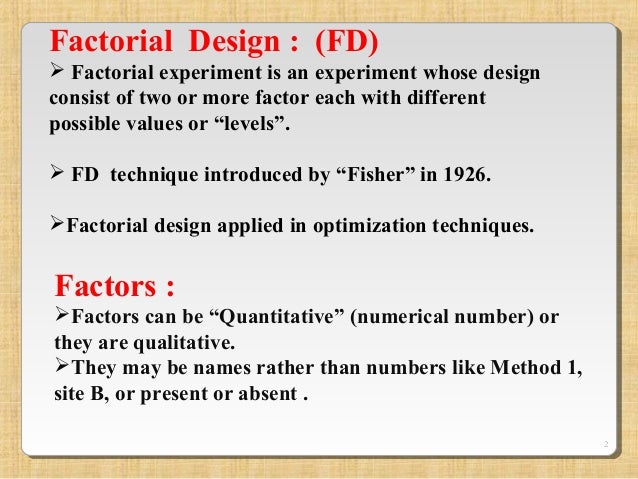
In such a design, the interaction between the variables is often the most important. This applies even to scenarios where a main effect and an interaction are present. In statistics, a full factorial experiment is an experiment whose design consists of two or more factors, each with discrete possible values or "levels", and whose experimental units take on all possible combinations of these levels across all such factors. Such an experiment allows the investigator to study the effect of each factor on the response variable, as well as the effects of interactions between factors on the response variable. Experimental design provides a structured approach to designing and conducting experiments, ensuring that the results are reliable and valid. When choosing an experimental design, one important consideration is which one delivers the most statistical power with the fewest subjects.
I have a Masters of Science degree in Applied Statistics and I’ve worked on machine learning algorithms for professional businesses in both healthcare and retail. I’m passionate about statistics, machine learning, and data visualization and I created Statology to be a resource for both students and teachers alike. My goal with this site is to help you learn statistics through using simple terms, plenty of real-world examples, and helpful illustrations. The ellipse can be projected onto each axis to obtain the familiar one-dimensional confidence intervals for each parameter (shown as blue points with error bars). The D-criterion reduces the variance of the parameter estimates and/or the correlation between the estimates by minimizing the area of the ellipse.
Understanding Main Effects?
In a general 2×3 experiment the ordered pair (2, 1) would indicate the cell in which factor A is at level 2 and factor B at level 1. For example, a shrimp aquaculture experiment[9] might have factors temperature at 25°C and 35°C, density at 80 or 160 shrimp/40 liters, and salinity at 10%, 25% and 40%. In many cases, though, the factor levels are simply categories, and the coding of levels is somewhat arbitrary.
How to classify variables in a factorial experiment design? - ResearchGate
How to classify variables in a factorial experiment design?.
Posted: Sat, 09 Mar 2024 08:00:00 GMT [source]
Onwards, the minus (−) and plus (+) signs will indicate whether the factor is run at a low or high level, respectively.
The first step in analyzing the results is entering the responses into the DOE table. In the columns to the right of the last factor, enter each response as seen in the figure below. It should be quite clear that factorial design can be easily integrated into a chemical engineering application. Many chemical engineers face problems at their jobs when dealing with how to determine the effects of various factors on their outputs.
Finally, it is important to note that if investigators include multiple, discrete IC’s in a factorial experiment the effects of the individual ICs may be limited to the extent that the various ICs exert their effects via similar or redundant pathways (Baker et al., 2016). Thus, to the extent that two ICs affect coping execution or withdrawal severity, their co-occurrence in the experiment could reduce estimates of their main effects via negative interaction. One might think of this as interventions “competing” for a limit subset of participants who are actually capable of change or improvement; in a sense this subsample would be spread across multiple active intervention components. First, non-manipulated independent variables are usually participant background variables (self-esteem, gender, and so on), and as such, they are by definition between-subjects factors. For example, people are either low in self-esteem or high in self-esteem; they cannot be tested in both of these conditions.
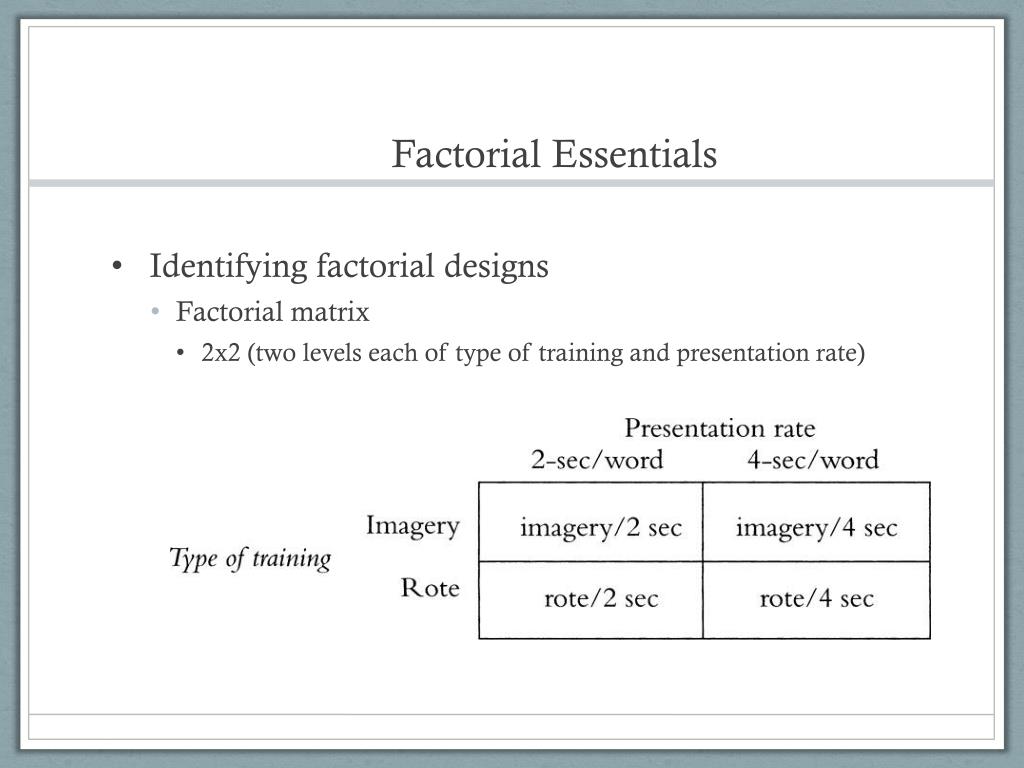
For experiments aimed at building behavioral interventions, we strongly recommend sticking with factors with two levels wherever possible, because these designs tend to be the most efficient for this purpose and also the most straightforward. Of course, the science has to drive the choice of experimental design, but efficiency is also an important consideration. The number of digits tells you how many independent variables (IVs) there are in an experiment, while the value of each number tells you how many levels there are for each independent variable. However, let’s imagine that she is also interested in learning if sleep deprivation impacts the driving abilities of men and women differently.
Thus it is important to be aware of which variables in a study are manipulated and which are not. Experimentwise error may be more of a problem in factorial designs than in RCTs because multiple main and interactive effects are typically examined. In a 5-factor experiment there are 31 main and interaction effects for a single outcome variable, and more if an outcome is measured at repeated time points and analyzed in a longitudinal model with additional time effects. If more than one outcome variable is used in analyses, the number of models computed and effects tested grow quickly. Various approaches have been suggested for dealing with the challenge posed by so many statistical comparisons being afforded by complex factorial designs (Couper et al., 2005; Green, Liu, & O’Sullivan, 2002). However, it is important to note that if a factorial experiment has been conducted for the purpose of screening multiple ICs to identify those that are most promising (as per the MOST approach), then statistical significance should probably be viewed as a secondary criterion.




No comments:
Post a Comment